A new free and citizen-focused solution to report, understand and document odour nuisance
An odour can be difficult to prove.
It is subjective, temporary and highly dependent on weather conditions. It may disappear before an inspector, local authority representative or technical expert has a chance to investigate it.
Yet when odours occur repeatedly, become intense or significantly affect quality of life, odour nuisance can become a real issue for residents and communities.
This is why ATMOTERRA has developed Odour.Live: a simple, accessible and practical solution enabling citizens to report and document odour nuisance.
👉 Discover Odour.Live for citizens
Report an odour in less than a minute
With Odour.Live, anyone can report an odour directly from a phone or computer.
No account is required.
No technical expertise is needed.
You do not need to know where the odour comes from.
Simply describe what you are experiencing: location, type of odour, intensity and level of annoyance.
Reports can be submitted anonymously.
Each observation contributes to a better collective understanding of odour nuisance across a territory.
Why report an odour?
Because a single report documents an event.
But repeated reports can reveal a pattern.
By collecting observations over time, it becomes possible to:
- identify areas that are regularly affected;
- identify periods and times when nuisance is most frequent;
- characterise odours and their intensity;
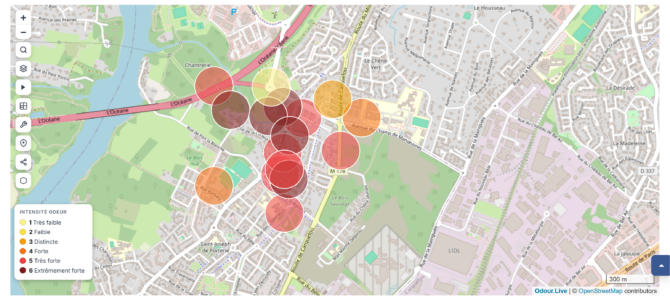
- visualise their geographical distribution;
- assess their frequency and duration;
- compare observations with weather conditions;
- identify potential correlations with activities or operating conditions;
- monitor how a nuisance evolves over time;
- assess whether corrective measures appear to have an effect.
Odour.Live therefore helps move from:
“It smells bad where I live.”
to:
structured, dated, location-based and analysable information.
A platform designed for citizens
One of the main objectives of Odour.Live is to make odour monitoring accessible to everyone.
🆓 Free
Reporting an odour is free and open to everyone.
👤 Anonymous
Users can report an odour without creating an account or identifying themselves.
📍 Location-based
The location of each report helps identify where odours are being experienced and progressively reveals affected areas.
📊 Structured
Users are not simply asked to leave a comment. They can characterise the odour and its intensity.
🌦️ Weather-aware
Weather conditions are essential for understanding how odours disperse. Odour.Live associates observations with relevant meteorological information to support further analysis.
🌍 Visible
Reports contribute to a collective picture of odour nuisance across a territory.
🔎 Analysable
As observations accumulate, recurring patterns and trends can emerge that would be difficult to identify from isolated testimonies.
An important innovation: turning personal experience into usable data
Odour nuisance presents a particular challenge.
The human nose is extremely effective at detecting odours, but personal observations are rarely collected in a structured and analysable way.
Odour.Live is designed to bridge this gap.
Citizens become, in a sense, human sensors of their environment.
Each report can provide information about:
WHEN?
When was the odour experienced?
WHERE?
Where was it detected?
WHAT?
What type of odour was perceived?
HOW STRONG?
How intense was it?
HOW OFTEN?
Was it an isolated event or a recurring problem?
UNDER WHAT CONDITIONS?
What were the weather and local conditions?
Over time, these observations can form a citizen-based record of odour nuisance.
Such a record can be particularly valuable when a situation needs to be understood, discussed with an operator, presented to local authorities or documented as part of an administrative process.
What does Odour.Live bring to associations and community groups?
Odour.Live is not only designed for individual residents.
The platform can also support associations, neighbourhood groups and local communities wishing to organise and structure a collective approach.
When a territory is affected by recurring odour nuisance, one question often arises:
How can we demonstrate that the problem is not simply one person’s experience, in one location, at one particular moment?
One answer is to build a record over time.
Several residents can independently report what they experience. The resulting observations can then help reveal affected areas, recurring periods and perceived intensity.
This can provide community groups with a factual basis to:
- monitor how a nuisance evolves;
- document a situation over time;
- prepare discussions with operators;
- engage with local authorities;
- support discussions with relevant administrations;
- assess changes following corrective measures;
- communicate about a situation using data rather than isolated testimonies.
The community can therefore maintain an independent record of what residents are experiencing.
👉 Discover Odour.Live for associations and community groups
📌 CASE STUDY — SecAnim in Plouvara: making an invisible nuisance visible
The situation involving SecAnim in Plouvara, Brittany, provides a particularly relevant illustration of the potential of such an approach.
During the summer of 2026, residents in and around Plouvara experienced significant odour nuisance associated with the rendering plant.
The situation occurred during a period of exceptionally hot weather, increased volumes of animal carcasses requiring processing and operational difficulties at the facility.
In an investigation published on 26 August 2026, independent French media outlet Splann! reported that odours were affecting several neighbouring communities, with residents describing difficulties using their gardens and keeping their windows open.
144 reports in less than two weeks
During this period, Odour.Live collected 144 reports between 12 and 25 August within a 7 km radius of the facility.
A large proportion of the reports came from the Saint-Donan area.
Even more significantly, the average reported intensity reached 5.3 out of 6, on a scale ranging from “very weak” to “extremely strong”.
These figures do not, by themselves, establish the source or cause of the odour.
But they provide something extremely valuable:
a collective, geographical and time-based picture of what residents were experiencing.
And this is precisely where the approach becomes useful.
An additional channel when traditional reporting channels are under pressure
The situation also illustrates the value of having an independent tool allowing residents to continue documenting their experiences.
According to Splann!, the telephone reporting line operated by SecAnim experienced periods of saturation during the episode.
Odour.Live, meanwhile, provided residents with a way to continue recording their observations.
The two approaches are not contradictory: they can be complementary.
Reporting directly to an operator can alert the operator to a problem.
Reporting through Odour.Live enables citizens to keep a structured record and contribute to a collective picture of the situation.
Data that can add another dimension to the discussion
On 21 August, the French authorities issued a formal notice to SecAnim requiring several measures aimed at addressing the odour nuisance. The measures included keeping certain doors closed, restoring wastewater treatment and taking action regarding animal materials generating odours.
The case illustrates an important point:
Odours can be the visible symptom, for residents, of broader operational difficulties.
Citizen observations do not replace regulatory inspections, technical measurements or official controls.
But they can help identify, document and monitor a situation over time.
👉 Read Splann!’s investigation into SecAnim in Plouvara
👉 Read the Le Monde article about rendering plants during the heatwave
A citizen-focused approach — not a tool against operators
It is important to remember that reporting an odour is not about blaming someone.
A report is information.
It can help operators, local authorities or relevant administrations become aware of a situation experienced on the ground.
Most importantly, a report does not automatically establish the source of an odour.
The objective is to understand the situation and, where nuisance is confirmed, support efforts to reduce it.
For operators themselves, accurate information about odour episodes can help identify sensitive periods, investigate potential causes and assess whether corrective measures are effective.
From perception to action
An effective approach to odour nuisance can therefore start with something very simple:
👃 I EXPERIENCE IT
I notice an odour that affects me.
📱 I REPORT IT
I describe it on Odour.Live.
📊 WE DOCUMENT IT
Reports accumulate and reveal patterns.
🔎 WE ANALYSE IT
Observations can be considered alongside location, timing, weather and potentially relevant activities.
🤝 WE DISCUSS IT
Residents, associations, operators, local authorities and administrations have better information to support constructive discussions.
✅ WE FOLLOW UP
After corrective measures are implemented, reports can help monitor whether the situation changes.
Citizens’ noses can become a valuable source of environmental knowledge
Odours are often considered difficult to measure.
They are.
But that does not mean they have to remain invisible.
Odour.Live offers a different approach: using residents’ perceptions as a structured source of information, while respecting their freedom to participate, their anonymity and their privacy.
A single report will not solve an odour problem.
But dozens or hundreds of well-structured reports can help document a situation, identify patterns, support investigations and monitor changes over time.
That is the ambition of Odour.Live:
putting technology at the service of citizens’ noses and more liveable communities.
Do you smell an odour that is affecting you?
Don’t keep it to yourself. Report it.
👉 Report an odour with Odour.Live
👉 Discover Odour.Live for associations and community groups
Odour.Live — a solution developed by ATMOTERRA to help communities better understand and manage odour nuisance, together.